
19 nov 2024
How AI is Shaping the Future of Project Controls


AI is changing project controls at a fast pace. Creative project controls engineers are getting much more effective. This is good news, but in this article, we want to warn the project controls community that the way how we use AI might paradoxically limit the impact of AI.

Data debt is preventing our industry from realizing the full potential of AI
At our Project Controls Inspiration Day in 2024, we asked a room full of project controls professionals a simple question: is your organization ready for the AI (r)evolution ?
The point we made that day was that AI's ultimate promise in project controls isn't writing reports faster. It's learning from the projects we have already delivered to improve overall project outcomes. Building the AI models that have these capabilities might not be our job, but ensuring sufficient high-quality data is accessible as a centralized source of truth is. In most project organizations, we don't manage that data well enough for anything to learn from it. Our industry suffers from data debt.
So the message was: start improving your project data now, so it's ready when the tools are.
Two years on, AI is in everyone's hands, but are our organizations really getting smarter in managing projects?
Let's be clear first: what AI is already doing for project controls engineers is good news. As Stijn argued in his recent blog post, AI takes over much of the mechanical work, so strong engineers can spend their time where it counts.
On our projects, we see it happening more and more. An engineer needs a view on progress, cost or risk, takes a dataset, asks an AI assistant to help, and has a working dashboard within hours. It solves a real problem and saves real time. That kind of initiative deserves encouragement, not a ban.
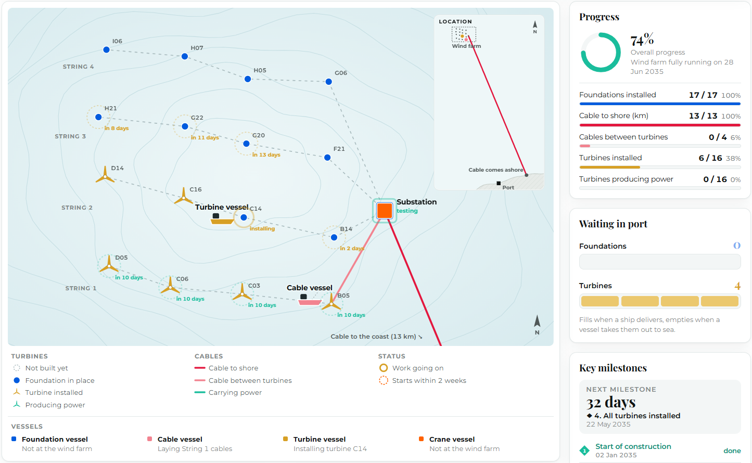
The dashboard above is an example of what this looks like in practice, built with AI for a fictional offshore wind farm. A map shows where construction stands, while the side panels summarize overall progress and key milestones at a glance.

The Excel culture created our data debt. Let's not repeat history.
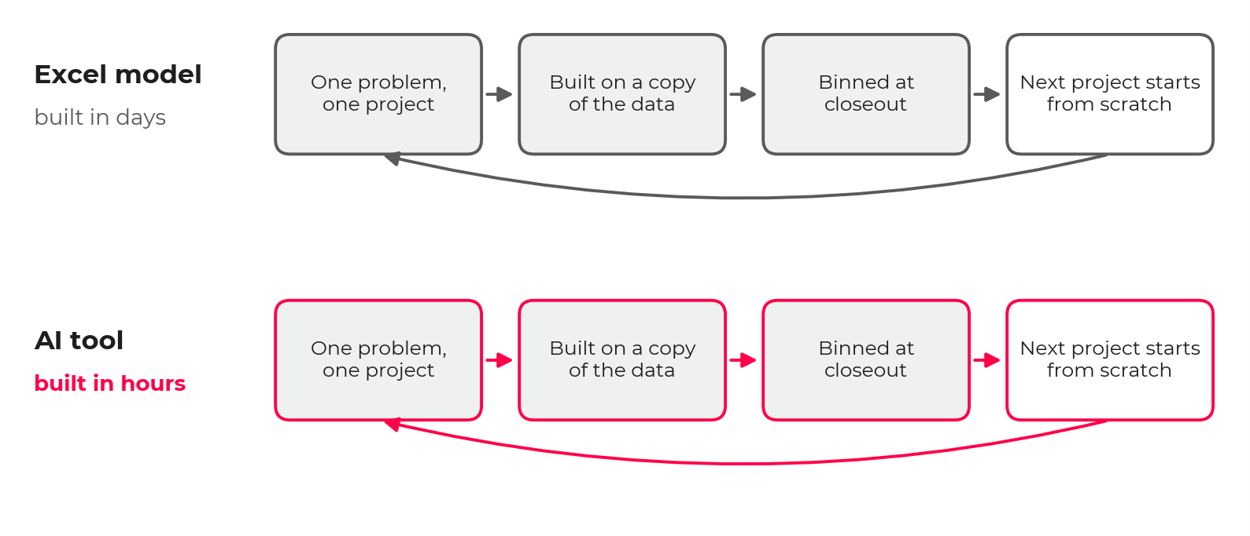
If this sounds familiar, it should. We have seen it before, with Excel. A good Excel model can solve a very specific problem on a very specific project. But it runs on a copy of the data, which is then reshaped to show what needs to be shown, and the knowledge behind it never becomes part of the organization's knowledge. When the project ends, that useful model almost always goes in the bin, and the next project starts from scratch again.
AI tools seem to have become the new Excels. A dashboard built in an afternoon is still a tool for one problem on one project, built on a copy of the data, and it will meet the same fate at closeout. The problem isn't new, but what is new is the speed: what used to take days of manual work now takes hours, so the pattern repeats faster than ever.
Building a tool used to take more than time. It needed collaboration with colleagues. You knew you didn't have all the knowledge to build it alone, so you asked the planner how the schedule was coded, the cost engineer what a cost code meant, the project manager what they would actually use on their projects.
AI changes that. It feels like it can fill in whatever knowledge we lack individually, so collaboration seems optional. But what AI fills in is generic knowledge. It doesn't know how your organization defines progress, which system already holds the data, or who will use the output. So the tool gets built alone, looks complete, and serves one person on one project.
Multiply that across a project organization and you get decentralization, resulting in data debt: information dispersed over personal tools and copies, definitions that differ from one tool to the next, and the context needed to interpret the data stuck in one person's head or chat history.
So, are we getting smarter? Individually, yes. As organizations, not necessarily. Every engineer becomes faster, while what an organization knows becomes less consistent and harder to reuse. And that organizational knowledge is exactly what AI would need to learn from our past projects . That is the AI paradox: the ease of AI scatters our efforts, and in doing so makes us less ready for AI.
What should a project controls lead do when an engineer shows up with a tool that saves hours every week? A tool is allowed to be local, temporary and specific to one project. What it rests on shouldn't be. That means two things:
First, the knowledge behind the tool, the approach, the assumptions, what the output should look like and the project context it depends on, gets captured in a shared, structured form the organization can build on.
Second, the project data stays in governed systems, with shared definitions. If two projects measure progress the same way and keep their history, the next project can learn from both.
At Proove, we hold ourselves to the same rule. We make sure all our AI efforts are centralized. Rather than everyone creating their own tools in their own corner, we collaborate on shared knowledge and governed data.
Two years after PCID 2024, our message hasn't changed, but it has become more urgent. AI will only make our projects smarter if what we learn on one project is still there for the next. The organizations that get this right won't be the ones with the most AI tools, but the ones whose tools leave something behind.
So here's our question to you: what happened to the last tool your team built? Is it still in use, or already in the bin? We'd love to hear your experience.