
21 May 2026
The best project controls engineers just got much better


It must have been sometime in 2016. I participated in an Integrated Baseline Review (IBR) session for an Earned Value Management System Proove had implemented. I was ready for any question. So was the PMP-certified project manager sitting next to me.
Except that not a single question was directed at either of us. Instead, all questions that day were addressed to the technical leads: “What will you do when these guys show you this kind of graph?”
On the drive home, I realized they were absolutely right. They had a very accurate judgment of my character: a theoretically grounded consultant who can talk his way out of almost any question. But more importantly, they touched the essence of project controls: it is not about the insights we create. It is about the actions people take because of those insights.
At Proove, our ambition is to enable data-driven project management, even if that means automating away large parts of our current services.
Data-driven project management means that the project manager and other key decision-makers rely on data, analytics, and metrics to guide their decisions. Their goal remains the same: to deliver the project within its constraints.
That last part matters. An effective data-driven project manager is not the one with the most data, but the one who acts earlier and better because of it.
If data-driven project management is the ambition, project controls is the system that enables it, not just the people.
At Proove, we define project controls as “the data-driven backbone of project management, ensuring access to accurate and relevant project data to deliver actionable insights and informed recommendations that drive decision-making and maximize stakeholder value.”
That definition intentionally breaks with the idea that project controls is about hiring a planning engineer to manually compile data and report on the past once a month.
Our ambition, as reflected in this definition, is to move beyond descriptive reporting. Project data should help anticipate what is likely to happen next and guide project managers in deciding how and when to respond.
AI and automation will fundamentally change how data is collected, processed, and visualized in project controls. But a crucial part will not change. Projects will still be delivered by people. Trade-offs will still require judgment. The project manager will remain accountable.
Since that IBR, project controls has evolved enormously as a profession. Today, we are exceptionally good at producing insights. Clean, well-structured BI dashboards with powerful KPIs and visually compelling graphs now cover all knowledge areas of project controls. Our data analytics consultants continuously impress our clients with their deliverables.
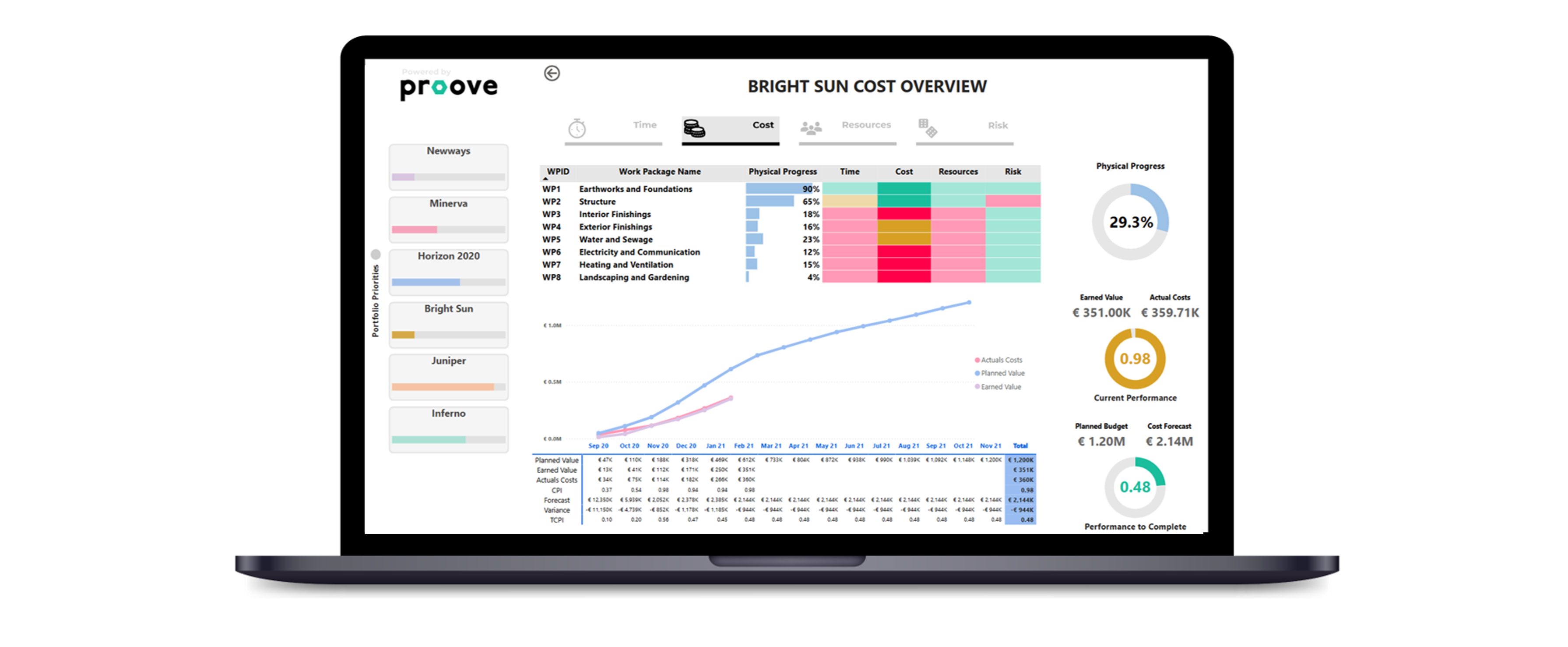
Yet despite this progress, the same fundamental questions remain:
The inconvenient truth is that the answers are often no. Dashboards make information visible, but visibility does not automatically lead to understanding. We often assume that meaning is self-evident. It is not. Many decision-makers struggle to correctly interpret visuals and translate them into concrete action. The result is projects that are rich in insight, but poor in data-driven action.
This is not a tooling problem, nor an individual failure. It is a capability gap we face as the project controls community.
As a community, we have become very good at producing dashboards. Our real challenge is not generating visuals, but turning insight into action. Bridging that gap requires two shifts:
That is why this year’s Project Controls Inspiration Day is, in part, dedicated to the question: how do we go from insight to action? Not by building better dashboards alone, but by strengthening the link between analysis and execution. If project controls wants to maximize its impact, this is the challenge we must solve together.