16 déc. 2025
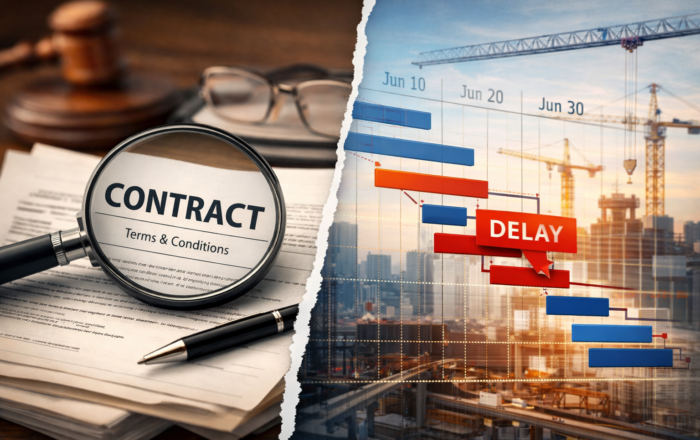
How contracts shape delay analysis (and why it matters for project controls)


Project controls professionals will not escape the impact of artificial intelligence. The question is not if the role will change, but how quickly we can adapt to it.
AI already enables the automation of many of the "mechanical" aspects of project controls. Activities can be generated, linked and structured within seconds. What previously required time, discipline, and tool proficiency can now be achieved almost instantly. If you want to see how Proove makes this work, read more here.
This shift does not make the role of the project controls professional obsolete. On the contrary, it exposes what the role was always meant to be. The profession is moving toward a more value-adding role: one that emphasizes interpretation, contextualization, validation and communication.
Despite rapid technological progress, project environments remain complex, uncertain and context-dependent. AI can generate structures, but it does not inherently understand project intent, stakeholder priorities or the nuances of execution strategies. Skilled professionals therefore remain accountable for the quality and validity of project controls outputs.
The project controls professional of the future is expected to provide project context, define control strategies, critically assess outputs and communicate insights effectively. In other words, the value shifts from building the model to making the model meaningful.
AI will not magically enable everyone to deliver a high-quality schedule. The best project controls professionals become significantly more powerful. The differentiator is no longer the ability to operate the tool. It is the ability to think critically, interpret context, challenge assumptions and make sound project decisions. Not every profile will transition equally easily.
Professionals who are primarily focused on tool operation and data entry face a structural challenge. If a planning engineer depends on others to define the project controls strategy and primarily contributes by implementing that strategy in the planning tool, the added value of that role becomes increasingly limited in an AI-augmented environment.
This is not a marginal issue. It concerns a substantial part of the professionals in our field. It is why we rethought our entire approach.
If the role changes, the underlying processes must evolve as well. At Proove, we have developed a planning framework built for this new reality. It reorders priorities around providing context, enriching knowledge, designing control approaches and validating models, shifting expert attention to where it creates the most value while AI handles model generation.
This shift has direct consequences for how we develop professionals. The essentials of project controls remain the foundation. That is how expertise is built and it cannot be shortcut. What changes is everything around it. We place less emphasis on tool training and more on judgment, communication and critical thinking. We train our engineers to interact effectively with AI, challenge outputs and structure knowledge reliably. The ability to exercise judgment, interpret context critically and work effectively with AI becomes the new measure of a strong project controls professional.
Professionals who develop these capabilities will be able to deliver the level of impact that project controls was always meant to have.
At Proove, we did not wait. We redesigned our approach, our framework and the way we train our professionals around it. If you want to explore what that means for your projects, let's talk.