25 mar. 2020
Planning and weather : an introduction


During the project setup phase, the team develops operational scenarios by defining equipment used, project phasing and operation methods, forming the initial schedule. Each operation is linked to specific weather limits such as wind speeds, temperature, curr
ent velocity and other environmental thresholds.
In many onshore projects, weather downtime is still estimated using broad averages based on past experiences. A simple rule of thumb, often expressed as a percentage of the working durations. This method ignores seasonal changes and gives no insight into years with unusually poor weather.
Offshore projects typically take a more detailed and data driven approach. Because weather plays such a critical role, teams rely on decades of detailed environmental data from monitoring stations. Each offshore operation comes with a complex set of weather limits. The next step is where the real challenge begins. Translating the many complex offshore variables into expected downtime based on decades of historical data, requires extensive Excel models that combine vast amounts of data to produce a single downtime estimate.
When assumptions inevitably change, such as a vessel change, a shift in start dates, or revised operational limits, the entire calculation must be revisited. Because the process is largely manual, updating these models is time consuming and can feel like starting from scratch over and over again.
By the time the weather downtime value is inserted in the schedule, either as a weather buffer at the end or a deterministic calendar adjusted for weather conditions, it often becomes fixed and untouchable. It is rarely updated during the project lifecycle, even though conditions and project assumptions change. As a result, the whole process ends up being slow, difficult to maintain and often not even maintained at all during the project. This creates a gap between the significant effort invested in calculating the “correct” weather downtime and how that information is actually used in planning.

After all the effort that goes into modelling weather downtime, one important truth remains: weather will always be an estimation, site conditions can’t be predicted with perfect accuracy. This shift in mindset opens the door to a more effective approach. Rather than treating downtime as a static value, we should make weather data integrated into the schedule and easily adaptable to project assumptions. A risk analysis simulating good and bad weather years, can then feed realistic scenarios straight into the plan
Sounds like a dream, right? This is where we see the added value of WeatherWise from EHAB.
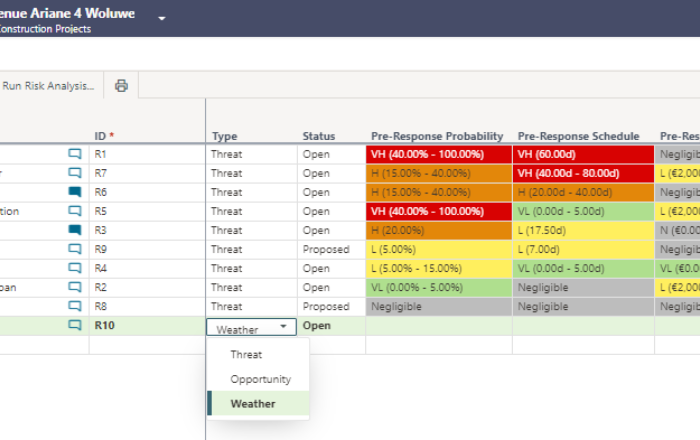
WeatherWise offers a platform designed to bring weather risk directly into the scheduling process using evolving weather patterns rather than static historical assumptions. It centralizes weather data, automates probabilistic downtime estimations and provides activity-specific weather calendars all integrated directly into planning tools. Allowing planners to generate scenario-based calendars in minutes instead of days.
Compared to traditional weather forecasting, EHAB brings several advantages:
Weather-sensitive projects depend on how well weather downtime is understood and managed, making this the perfect moment to rethink whether the traditional, static approach still serves your planning needs. Instead, shifting the focus from “calculating the perfect downtime value” to using weather information in a smarter, more dynamic way.
With WeatherWise by EHAB, integrating weather intelligence directly into your schedule becomes possible. This groundbreaking shift in mentality offers clearer insight and better adaptability, helping teams create more realistic schedules and improve decision-making throughout the project lifecycle.
At Proove, we combine our expertise in project controls with EHAB’s advanced weather‑risk platform. If you’re curious how WeatherWise could strengthen your project controls or want to explore what a smarter workflow could look like, watch our recent webinar on offshore projects. We’d be happy to connect to see how Proove and EHAB can support you in improving the way weather downtime is managed on your projects.